Friday, May 27, 2016

Wednesday, May 25, 2016
24 May
Today it rained! And by rain, I mean a light drizzle that barely counts as rain. According to taxi drivers and Ammanis, this is the first time in the history of Jordan that it's ever rained in May in Amman. Typically there's about a week per year in December where it rains, and the rest of the year is utterly dry. I've witnessed history. Sort of.
25 May
Happy Independence Day! It is currently almost midnight and our group got back from an excursion to the Baadia. This page is a placeholder until I get to updating it, as I am exhausted.
Okay here's the actual update. Our group left Amman around 2PM and drove to the city of Mafraq, north of Amman and only about 15-20km from the Syrian border, along a highway to Dara'a, Syria. Driving through the city of Mafraq, it's notably a much smaller city than Amman, with about 60,000 inhabitants. Outside the vast, sprawling city of Amman, the remaining half of Jordan's population is spread out in many small cities, villages, and tribes. Around Mafraq, you could see the military present, with offices, signs, even tanks and planes in roundabouts.
After Mafraq, we headed east. Along the road, we passed the Zaatari refugee camp, a refugee camp for the hundreds of thousands of Syrian refugees crossing the border into Jordan. Zaatari has a population of around 80,000, making it one of the largest cities in Jordan. The camp is overcrowded and has subpar conditions inside. In recent years, informal leadership and organization have arose out of the chaos of the camp, but issues like water, sanitation, and security still plague the camp. As a response to the conditions and overcrowding in Zaatari, the Jordanian government created a new camp further in the interior of the country, the Azraq refugee camp. It gained a bit of publicity when John Green, of the Youtube channel vlogbrothers, visited Azraq and made videos about the refugees there. Our group didn't actually enter inside the camp, just pass by the gate. But we did have a lecture about the Zaatari camp beforehand.

Our first destination was the archaeological town of Umm Al-Jimaal. The name means "Mother of Camels" in Arabic. However, in Arabic, only the consonants are written, so Jimaal, written like "jmal", could, and apparently once was, known as Umm Al-Jamaal, "Mother of Beauty", showing the importance and admiration the Arabs have for camels. Our guide told us that camels could survive a week crossing the desert without food or water. It's no wonder the ancient bedouins would value camels so highly.
The ruins itself were from every period in Jordanian history, from the Nabataeans to the Umayyads. It truly felt like an ancient city. The ruins were filled with the remains of buildings, community centers, water infrastructure, temples, homes, etc. The site was so extensive you could get lost in all the remains. Interestingly, our guide explained that the volcanic rocks that made up the ruins were locally sourced.
Our guide told us a little history about the region. The entire western part of Jordan used to be renown for being heavily forested, a far cry from the desert we now live in. A traveler in the time of the Caliphates wrote that a naked man could travel from modern-day Aqaba (along the Red Sea) to Damascus, and no one would see him due to all the trees. Even in the late 19th Century, the Ottomans decided to build a railroad from Damascus that crossed through modern-day Jordan to Mecca, and they had to cut down millions of trees in the process. However, western Jordan is just barely on the edge of the more lush environment along the Eastern Mediterranean Coast, and the interior desert. Although people farm the region extensively, and hardy plants and shrubs can be found everywhere, there's very little that could be considered a thick forest, not to mention the millions of trees that used to dominate. So what happened in just a century?
After Umm Al-Jimaal, we traveled into the desert to visit a Bedouin Sheikh, Sheikh Khaled. One thing to note is that, in Arabic, there's a distinction made between two different kinds of deserts, the Sahraa' (صحراء), and the Baadia (بادية). The desert that we imagine as the the lifeless, sandy, hot desert, the classic "desert", mostly exists in places like Morocco and the Arabian Peninsula. The plural of Sahraa', Sahaara (صحارى), is where the name Sahara Desert comes from. The Baadia is what exists in Jordan. It's more of a semi-desert. It's inhabited by nomadic bedouins, features some level of agriculture, and shrubbery and grasslands. The conditions are still extreme, being very hot during the day and very cold at night. Water is still scarce.
Our second destination was an apricot farm in Shiekh Khaled's tribe, owned by a friend of his. Our guide explained that there's an Islamic norm that when a traveler visits a Muslim's farm, the traveler is permitted to eat from the farm to his content, but he should not take any food with him. In the same spirit, the farm owner allowed us to eat apricots from his farm. They were delicious.
The farm was actually just around a mile away from the Syrian border. Many in the group took selfies with Syria. We could actually see white trucks that apparently were from the Syrian Army. The experience actually demonstrated how strange the concepts of national borders are. National borders seem intuitive when viewed on a map, and they do serve important purposes. However, they seemed strange and far away when actually standing next to the Jordanian-Syrian border. After all, there's nothing you could see that made Jordan look any different from Syria. People in Jordan conduct their lives, like growing apricots, barely a mile away from the border. The government here is one of the biggest military allies of the my home government. Yet, if I happened to cross the invisible line, I suddenly am in a country ravaged by civil war. My home government is actively supporting rebellion against the government. I'm considered to be in danger just by being an American in Syria. As someone else in our group put it, "this is the closest I've been to an enemy of the US".
Our third and final destination was the home of Sheikh Khaled. We washed and entered a small structure, where we listened to the Sheikh as he told us a bit about life in the Baadia.
In Jordan, the word "Bedouin" is an adjective describing a way of life. To be a Bedouin, one must live nomadically in the Baadia, searching for food and water. If a member of a Bedouin tribe moves to a city and lives a settled life, his descendants are no longer considered Bedouins. Our guide told us that he is not a Bedouin, but is very proud of his Bedouin heritage. And many Jordanians who originated in Jordan are similar, being not Bedouin, but proud of their Bedouin heritage.
In Jordan, a sheikh can an Islamic scholar. But in the context of Bedouins, the sheikh is the leader of the tribe. He's the authority and arbiter. Whenever there's a conflict or argument, the sheikh is brought in to resolve the dispute. This can be small disputes about property or personal relationships. Or it could be crimes like unintentional murder. If a man disputes the judgment of the sheikh, he's basically dead to the tribe. He's no longer considered a member and will be ignored by the tribe. However, if the sheikh loses the approval of the tribe, he can be replaced. Some sheikhs have one hell of a job managing and arbitrating for large tribes up to 12,000 people. But they do play a very important role in Jordan.
They're also the representatives of their tribes in Jordanian government. They present the concerns of the tribe and protect their interests to the king. The duty of the Jordanian king is to develop and maintain relationships with the sheikhs in Jordan, and meet their needs. In turn, the sheikhs support the sovereignty of the king, and the stability of the Jordanian kingdom. The tribe's choice for sheikh is then presented to the king, who in turn appoints the sheikh of the tribe. It's both a bottom-up and top-down approval. Nowadays, many living in Jordan come from outside the tribal system, especially refugees who come from urbanized and settled places in Palestine, Lebanon, Iraq and Syria. But the members of the Bedouin tribes still make up much of the population, and their satisfaction is key to the survival of Jordan.
In Arab culture, hospitality is very highly valued. When an ISIS fighter was poisoned in the house of an Arab, it made big news because it broke deeply held norms in the culture. However, this importance on hospitality is dialed up to 11 in Bedouin culture. When a traveler arrives at a Bedouin home, he is entitled to eat, drink, and stay for three days. In that time, the host is not allowed to ask who he is, where he is from, or why he's here. Professor Sullivan shared a story where a student on a study abroad program was assigned to a Bedouin host family. Armed with only an address, he arrived to his hosts, where he was fed and housed for three days. After that time passed, the student realized that the family had no idea why he was here, and never heard of a being a "host family" for a foreign student. Turns out he went to the wrong place.
Afterwards, we had dinner in Sheikh Khaled's home, bread and various dips and dishes. Very delicious. We also were served tea around a fire. Afterwards, we loaded into the bus and headed home, where a pile of Arabic homework greeted us.


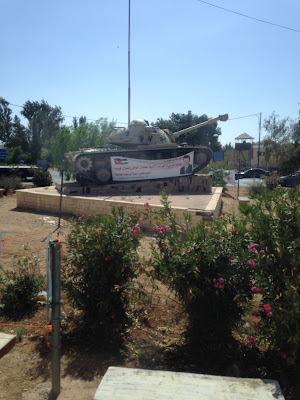




Okay here's the actual update. Our group left Amman around 2PM and drove to the city of Mafraq, north of Amman and only about 15-20km from the Syrian border, along a highway to Dara'a, Syria. Driving through the city of Mafraq, it's notably a much smaller city than Amman, with about 60,000 inhabitants. Outside the vast, sprawling city of Amman, the remaining half of Jordan's population is spread out in many small cities, villages, and tribes. Around Mafraq, you could see the military present, with offices, signs, even tanks and planes in roundabouts.
After Mafraq, we headed east. Along the road, we passed the Zaatari refugee camp, a refugee camp for the hundreds of thousands of Syrian refugees crossing the border into Jordan. Zaatari has a population of around 80,000, making it one of the largest cities in Jordan. The camp is overcrowded and has subpar conditions inside. In recent years, informal leadership and organization have arose out of the chaos of the camp, but issues like water, sanitation, and security still plague the camp. As a response to the conditions and overcrowding in Zaatari, the Jordanian government created a new camp further in the interior of the country, the Azraq refugee camp. It gained a bit of publicity when John Green, of the Youtube channel vlogbrothers, visited Azraq and made videos about the refugees there. Our group didn't actually enter inside the camp, just pass by the gate. But we did have a lecture about the Zaatari camp beforehand.

A screenshot from Google Maps, with annotations, to put it in perspective. The refugee camp is about 10 km from the city.
Our first destination was the archaeological town of Umm Al-Jimaal. The name means "Mother of Camels" in Arabic. However, in Arabic, only the consonants are written, so Jimaal, written like "jmal", could, and apparently once was, known as Umm Al-Jamaal, "Mother of Beauty", showing the importance and admiration the Arabs have for camels. Our guide told us that camels could survive a week crossing the desert without food or water. It's no wonder the ancient bedouins would value camels so highly.
The ruins itself were from every period in Jordanian history, from the Nabataeans to the Umayyads. It truly felt like an ancient city. The ruins were filled with the remains of buildings, community centers, water infrastructure, temples, homes, etc. The site was so extensive you could get lost in all the remains. Interestingly, our guide explained that the volcanic rocks that made up the ruins were locally sourced.
Our guide told us a little history about the region. The entire western part of Jordan used to be renown for being heavily forested, a far cry from the desert we now live in. A traveler in the time of the Caliphates wrote that a naked man could travel from modern-day Aqaba (along the Red Sea) to Damascus, and no one would see him due to all the trees. Even in the late 19th Century, the Ottomans decided to build a railroad from Damascus that crossed through modern-day Jordan to Mecca, and they had to cut down millions of trees in the process. However, western Jordan is just barely on the edge of the more lush environment along the Eastern Mediterranean Coast, and the interior desert. Although people farm the region extensively, and hardy plants and shrubs can be found everywhere, there's very little that could be considered a thick forest, not to mention the millions of trees that used to dominate. So what happened in just a century?
After Umm Al-Jimaal, we traveled into the desert to visit a Bedouin Sheikh, Sheikh Khaled. One thing to note is that, in Arabic, there's a distinction made between two different kinds of deserts, the Sahraa' (صحراء), and the Baadia (بادية). The desert that we imagine as the the lifeless, sandy, hot desert, the classic "desert", mostly exists in places like Morocco and the Arabian Peninsula. The plural of Sahraa', Sahaara (صحارى), is where the name Sahara Desert comes from. The Baadia is what exists in Jordan. It's more of a semi-desert. It's inhabited by nomadic bedouins, features some level of agriculture, and shrubbery and grasslands. The conditions are still extreme, being very hot during the day and very cold at night. Water is still scarce.
Our second destination was an apricot farm in Shiekh Khaled's tribe, owned by a friend of his. Our guide explained that there's an Islamic norm that when a traveler visits a Muslim's farm, the traveler is permitted to eat from the farm to his content, but he should not take any food with him. In the same spirit, the farm owner allowed us to eat apricots from his farm. They were delicious.
The farm was actually just around a mile away from the Syrian border. Many in the group took selfies with Syria. We could actually see white trucks that apparently were from the Syrian Army. The experience actually demonstrated how strange the concepts of national borders are. National borders seem intuitive when viewed on a map, and they do serve important purposes. However, they seemed strange and far away when actually standing next to the Jordanian-Syrian border. After all, there's nothing you could see that made Jordan look any different from Syria. People in Jordan conduct their lives, like growing apricots, barely a mile away from the border. The government here is one of the biggest military allies of the my home government. Yet, if I happened to cross the invisible line, I suddenly am in a country ravaged by civil war. My home government is actively supporting rebellion against the government. I'm considered to be in danger just by being an American in Syria. As someone else in our group put it, "this is the closest I've been to an enemy of the US".
Our third and final destination was the home of Sheikh Khaled. We washed and entered a small structure, where we listened to the Sheikh as he told us a bit about life in the Baadia.
In Jordan, the word "Bedouin" is an adjective describing a way of life. To be a Bedouin, one must live nomadically in the Baadia, searching for food and water. If a member of a Bedouin tribe moves to a city and lives a settled life, his descendants are no longer considered Bedouins. Our guide told us that he is not a Bedouin, but is very proud of his Bedouin heritage. And many Jordanians who originated in Jordan are similar, being not Bedouin, but proud of their Bedouin heritage.
In Jordan, a sheikh can an Islamic scholar. But in the context of Bedouins, the sheikh is the leader of the tribe. He's the authority and arbiter. Whenever there's a conflict or argument, the sheikh is brought in to resolve the dispute. This can be small disputes about property or personal relationships. Or it could be crimes like unintentional murder. If a man disputes the judgment of the sheikh, he's basically dead to the tribe. He's no longer considered a member and will be ignored by the tribe. However, if the sheikh loses the approval of the tribe, he can be replaced. Some sheikhs have one hell of a job managing and arbitrating for large tribes up to 12,000 people. But they do play a very important role in Jordan.
They're also the representatives of their tribes in Jordanian government. They present the concerns of the tribe and protect their interests to the king. The duty of the Jordanian king is to develop and maintain relationships with the sheikhs in Jordan, and meet their needs. In turn, the sheikhs support the sovereignty of the king, and the stability of the Jordanian kingdom. The tribe's choice for sheikh is then presented to the king, who in turn appoints the sheikh of the tribe. It's both a bottom-up and top-down approval. Nowadays, many living in Jordan come from outside the tribal system, especially refugees who come from urbanized and settled places in Palestine, Lebanon, Iraq and Syria. But the members of the Bedouin tribes still make up much of the population, and their satisfaction is key to the survival of Jordan.
In Arab culture, hospitality is very highly valued. When an ISIS fighter was poisoned in the house of an Arab, it made big news because it broke deeply held norms in the culture. However, this importance on hospitality is dialed up to 11 in Bedouin culture. When a traveler arrives at a Bedouin home, he is entitled to eat, drink, and stay for three days. In that time, the host is not allowed to ask who he is, where he is from, or why he's here. Professor Sullivan shared a story where a student on a study abroad program was assigned to a Bedouin host family. Armed with only an address, he arrived to his hosts, where he was fed and housed for three days. After that time passed, the student realized that the family had no idea why he was here, and never heard of a being a "host family" for a foreign student. Turns out he went to the wrong place.
Afterwards, we had dinner in Sheikh Khaled's home, bread and various dips and dishes. Very delicious. We also were served tea around a fire. Afterwards, we loaded into the bus and headed home, where a pile of Arabic homework greeted us.

A government building (if I remember correctly) in Mafraq

A group of Syrian refugees being handed blankets and other supplies in Mafraq
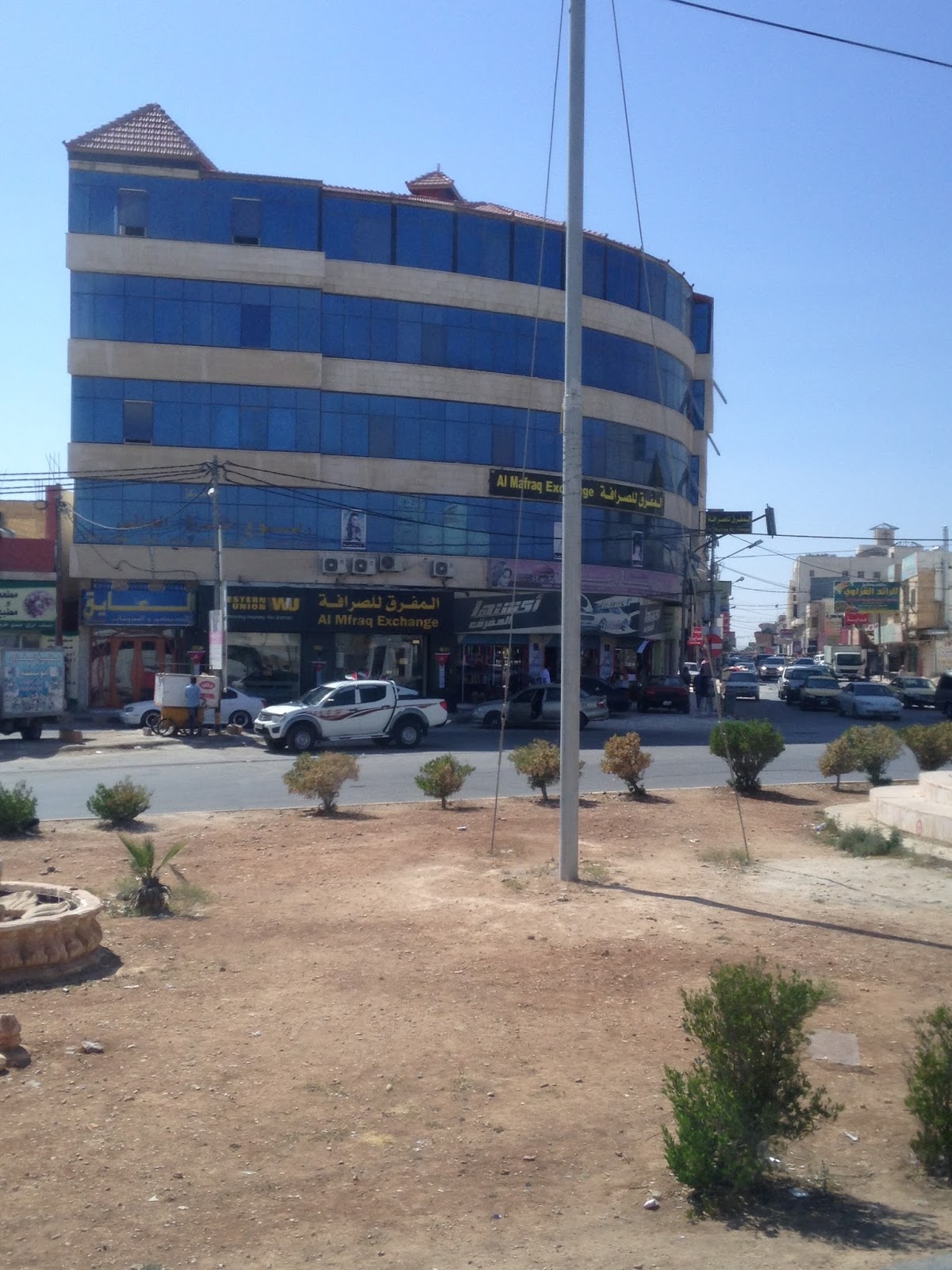
A mall in Mafraq

A tank sitting in the middle of a roundabout

Side view of the tank

View of the Baadia outside Mafraq

Another view


Our first view of Umm Al-Jimaal

Taken from Umm Al-Jimaal

Umm Al-Jimaal


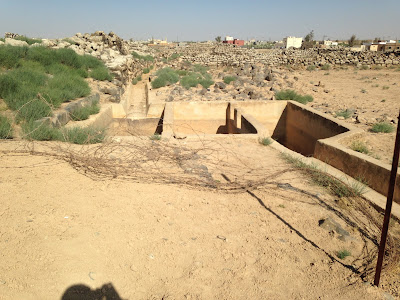
What's left of a reservoir

Connected to a larger reservoir, probably something with water control

Greenhouses along a highway

This was in another roundabout near Mafraq

The apricot trees. My shadow's probably second from the left. Not really sure.

The watchtower in the distance is on the Syrian border
You can see Syrian villages in the distance


William went full Bedouin

Our meal at Sheikh Khaled's home
Monday, May 23, 2016
23 May
Same schedule - Qasid, lecture on refugees in Jordan.
I tried making hummus today. I used a simple recipe I found online using chickpeas, tahini, garlic, and lemon juice. Most online recipes call for a food processor, but we unfortunately don't have one in our apartment, and I can't justify buying one for two months. So, I made do with mashing chickpeas with a fork and hand-chopping garlic. The end result had a texture that was nothing like the creamy smooth beauty in Jordanian restaurants. Instead, it more resembled partially kneaded dough that wasn't watered enough, or maybe the "cheese" in MREs, and had chunks of chickpea and garlic. Surprisingly, it did manage to taste like hummus.
Next time I'll try using more liquid, in the form of lemon/lime juice (limes are much cheaper here compared to imported lemons) and olive oil. Maybe I should invest in a mortar and pestle for smoother hummus.

The hummus in question. As you can see, the texture isn't quite there.
Sunday, May 22, 2016
22 May
Second day of classes today. Some people moved up from our class, and some people moved down into ours. For some reason everyone seemed exhausted in our class compared to the first class last Thursday, including me. The four straight hours of Arabic is definitely going to be a challenge once we go into the details on grammar and whatnot. The instructors here definitely use a lot of exercises in class. For example, one exercise was to take a list of words and create a paragraph about them. Another was to describe pictures on a projector using new words in 3ammiyyah. Another was to charades/describe (in Arabic) a word to someone who has to guess it. Stuff like that.
I'd love to make some hummus here in our apartment. Unfortunately it doesn't look like we have access to a food processor. Maybe if it's cheap enough, we might consider buying one for this trip. But probably not. How cheap could a food processor get?
Culture/Language notes:
I'd love to make some hummus here in our apartment. Unfortunately it doesn't look like we have access to a food processor. Maybe if it's cheap enough, we might consider buying one for this trip. But probably not. How cheap could a food processor get?
Culture/Language notes:
- A truck was driving by in our residential area today. There was speakers shouting some words that sounded like slogans. It sounded vaguely angry or demanding, like a political protestor. I can't tell, I couldn't understand the broadcast. But it looks like trucks circulating around neighborhoods is a common way to get stuff across.
- Fascinating lecture today by Dr. Bader al-Madi, a Jordanian political scientist. I made notes, but I don't really want to rehash it into this blog post.
- Many things that would be refrigerated constantly in America aren't so much here. Some eggs aren't refrigerated. A lot of boxed juice isn't refrigerated. Milk isn't refrigerated until opened. It makes me wonder what's different. Is it a difference in quality, in the eggs/milk produced here from different chickens/cows, in the packaging, or is it really just a cultural norm in America to refrigerate all dairy all the time?
No pictures today.
Saturday, May 21, 2016
21 May
The whole group took a day trip to the nearby city of Jerash, which is about an hour north of Amman and near both the Palestinian and Syrian borders. In Jerash we saw the ruins of the ancient city of Jerash in Greco-Roman times, as well as the 'Ajloun Castle.


Culture/Language notes:
- The Jordanian and Palestinian flags are very similar. The only difference is a star on the red chevron on the Jordanian flag. There's a lot of Palestinian flags flown here, sometimes with the Jordanian one and sometimes without.
- I bought a kuffiyeh today. It's actually quite nice to wear in the hot desert sun, as it keeps your head cool out of the sun. It takes a bit of know-how to wrap it around your head, and unfortunately I look like a complete foreigner in it.

The gate to the ruins of Jerash
The Oval Forum

The marketplace

A view of the ruins with the modern city of Jerash in the background

I don't actually remember what this was part of
Two members of our excursion singing in a Roman amphitheater. It doesn't show in this video but the acoustics are incredible in them

The Temple of Artemis

Apparently the kind of plant that lives in this desert ruins

A mosaic that was the floor of a Byzantine Church
A look around the Mediterranean landscape
There's more pictures, but I'm exhausted. I'll post them tomorrow or something.
Friday, May 20, 2016
20 May
On Fridays, Qasid doesn't have classes, so today was a free day. I decided to look around the city some more, including the University of Jordan. I also took my first taxi ride in Jordan today.
Culture/Language notes:


Culture/Language notes:
- Religious phrases are everywhere on buildings, storefronts, pieces of paper stuck to posts, and even graffiti. Many homes and businesses feature the inscription باسم الله الرحمن الرحيم ما شاء الله (In the name of God, the most gracious, the most merciful, God has willed it). I've seen سبحان الله (Glory of God) and الله اكبر (God is greater) on pieces of paper in the street, and محمد رسول الله (Muhammad is the prophet of God) sprayed onto a pedestrian bridge. One person said it was like how people in America have signs in their home saying things like "bless this house" or "Jesus loves my car" or "hallelujah".
- The sound of the muezzin (people publicly reciting the call to prayer) carry everywhere in the city. There's a masjid not too far from here, and I can very clearly hear it at every prayer cycle. It's beautiful, cuts through the sound of the city, and seems to soar over the traffic and hubbub of Amman. Interestingly, one of the few places in America to have muezzin is Hamtramck, a small city surrounded by Detroit, and only about 45 minutes from my home.
- Life in Amman is, for a lack of a better word, imprecise in some ways. The cost of items sometimes fluctuates and for an item that's, say, 1.68 JD you might be charged 1.6 JD or 1.5 JD or 1.75 JD. Also bargaining is expected in places like bazaars, where listed prices are often 1.5 to 2 times the actual value. Some cafes won't have a menu, but will expect that people will know what kind of fare they have. Streets have few street signs, and lane dividers are ignored. Parking is oftentimes fast and loose, as well as changing lanes. Street addresses are never used. Navigation is done based on landmarks and relative directions, and large streets have completely different colloquial names (ex. Queen Rania al-Abdullah Street is known as University Street). If you say something like "59394 Queen Rania al-Abdullah Street" he'll just give you a weird look. Instead, you have to say a landmark like Mukhtar Mall or Diwaar al-Medineh and direct them from there. Point is, things are often done in a way that's less exact and more relative than in America. It takes a bit more people savviness, I suppose, to live here, but also means that people seem to interact more with each other.
- Being in Amman makes me appreciate culture difference much more than before. Going to Korea doesn't feel very foreign, growing up in a Korean-American community and because of the heavy American influence there. I've visited Italy as a tourist, in areas for tourists, but that area in Western Europe definitely feels somewhat familiar. Being in Amman, which is different than any culture I've been in, makes me aware of small cultural norms. Because of that, and my incompetence in Arabic, getting around definitely is uncomfortable and awkward. But it's also a great learning experience and hopefully my Arabic will improve after lots of awkward interactions.

A view of the Islamic Cultural Center and Masjid on the University of Jordan campus

A Little Caesars Pizza near the University. There's a lot of restaurants around it that cater to foreign tastes, apparently including cheap American pizza.

A sign outside the University, next to a gate. The whole campus is gated off, with entrances all around

Another gate

Completely different from Dunkin Donuts. The menu is all in English and every customer looked like an expat or tourist
Subscribe to:
Posts (Atom)